
Welcome to the Army Public School Babina digital learning portal. These specialized chapter notes are curated specifically to help our students master core Mathematics concepts and prepare efficiently for school and board examinations.
A Discovery That Changed the World
Imagine you’re building a treehouse and need to make sure the walls are perfectly straight. Or perhaps you’re trying to find the shortest path across a park. How would you figure out these distances?
Over 2000 years ago, an ancient Greek mathematician made a discovery that would help solve these problems forever. This discovery is called Pythagoras’ Theorem, and it’s one of the most famous and useful rules in all of mathematics.
APS BABINA STUDY TIP
- Don’t worry if maths isn’t your favourite subject – by the end of this guide, you’ll not only understand Pythagoras’ Theorem but you’ll also see why it’s so brilliant and useful!
What is Pythagoras’ Theorem?
Pythagoras’ Theorem is a rule that applies to right-angled triangles – triangles that have one angle of exactly 90 degrees (a square corner).
The Simple Statement
Here’s what the theorem says in plain English:
“In a right-angled triangle, the square of the hypotenuse is equal to the sum of the squares of the other two sides.”
But what does that actually mean? Let’s break it down.
KEY WORDS YOU NEED TO KNOW
- ✓ Right-angled triangle: A triangle with one 90° angle (like the corner of a square)
- ✓ Hypotenuse: The longest side of a right-angled triangle. It’s always opposite (across from) the right angle
- ✓ The two shorter sides: These are the other two sides that form the right angle
The Area Way of Thinking About It
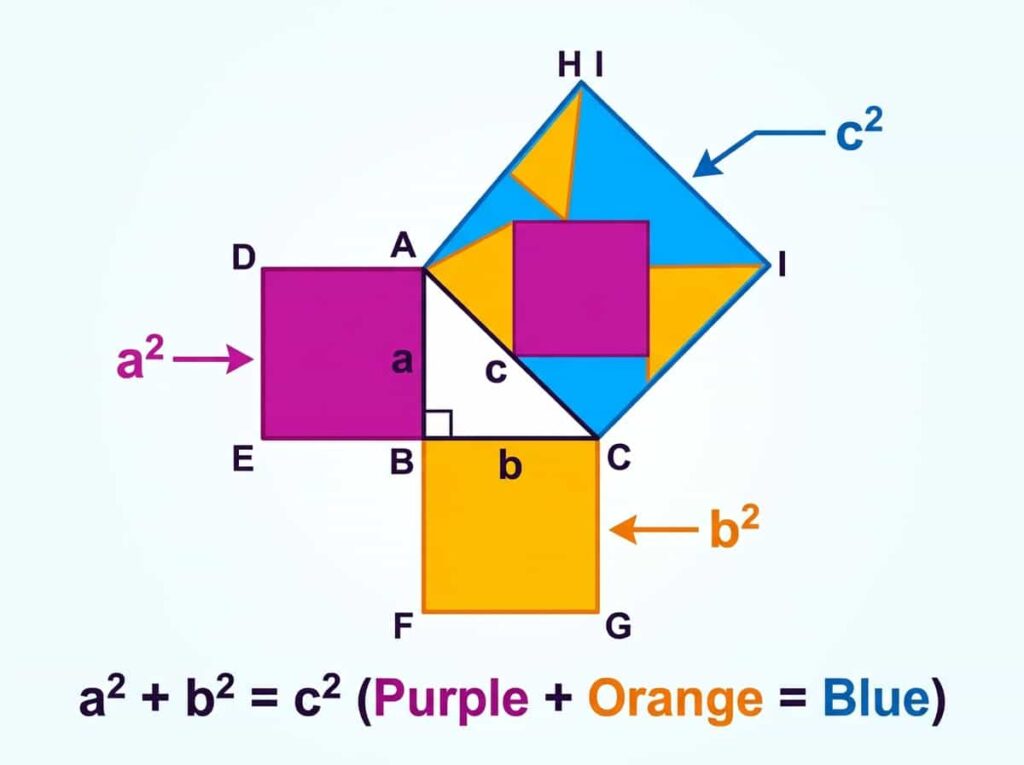
Here’s a really cool way to understand the theorem. Imagine you draw a square on each side of a right-angled triangle. Pythagoras’ Theorem tells us that:
The area of the square on the hypotenuse = the area of the square on one shorter side + the area of the square on the other shorter side
This is why the theorem is so beautiful – it’s all about areas fitting together perfectly!
The Formula: $a^2 + b^2 = c^2$
If we label the sides of a right-angled triangle like this:
* a = one shorter side
* b = the other shorter side
* c = the hypotenuse (the longest side)
Then Pythagoras’ Theorem can be written as:
$$a^2 + b^2 = c^2$$
This is the famous formula that students all over the world learn!
What does the formula mean?
* $a^2$ means “a multiplied by a” (a squared)
* $b^2$ means “b multiplied by b” (b squared)
* $c^2$ means “c multiplied by c” (c squared)
So the formula is saying: “a squared plus b squared equals c squared”.
Who Invented Pythagoras’ Theorem?
The Man Behind the Name
The theorem is named after Pythagoras of Samos, a Greek mathematician who lived from approximately 570 BC to 495 BC.
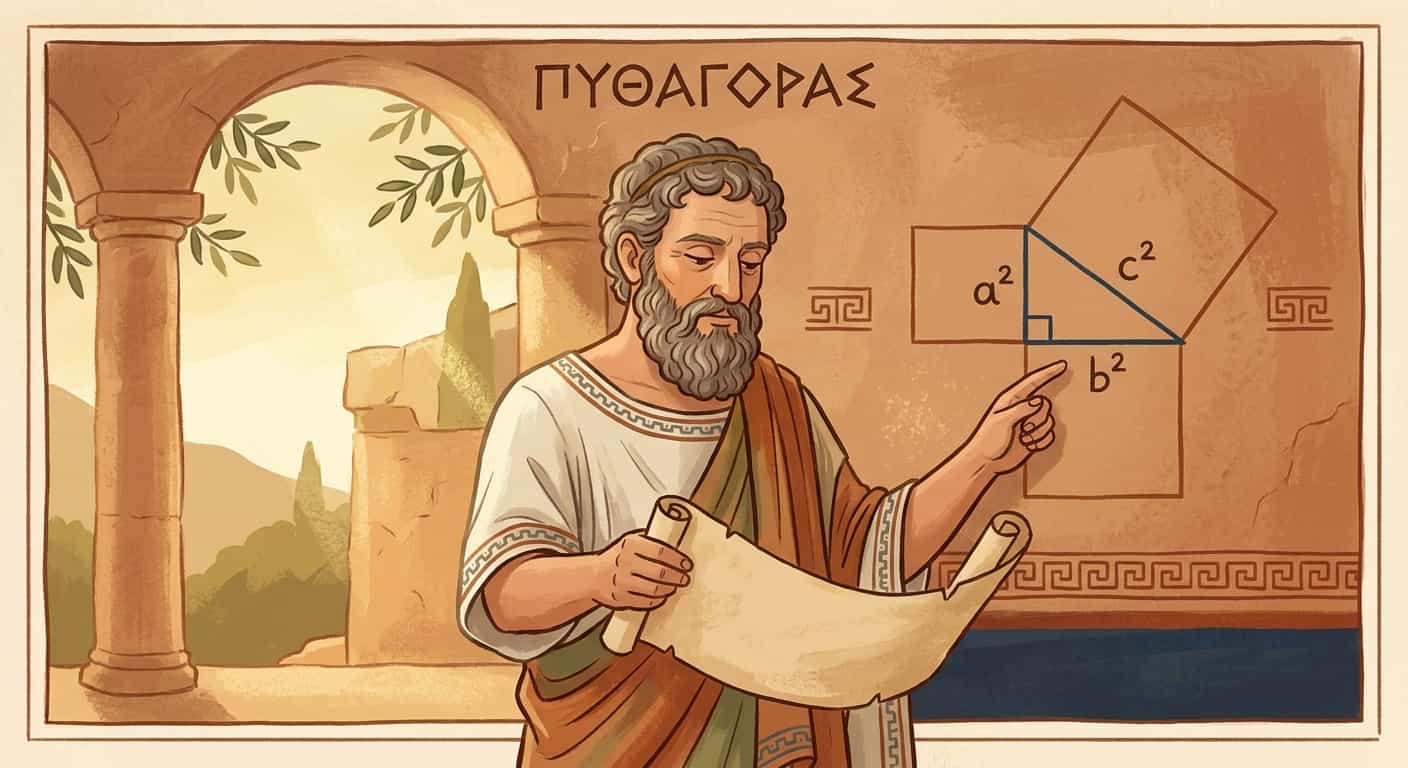
Pythagoras was more than just a mathematician – he was also a philosopher and the founder of a group called the Pythagorean brotherhood. He’s often described as the first “pure” mathematician.
However, here’s an interesting twist: Pythagoras might not have been the first person to discover this theorem!
The Real History
HISTORICAL DISCOVERIES
- ✓ Babylonian mathematicians understood the formula over 1000 years before Pythagoras
- ✓ Ancient Egyptians used 3-4-5 triangles to construct perfect right angles when building pyramids
- ✓ The Rhind Papyrus (from around 1788-1580 BC) contains evidence of the theorem
So why is it called Pythagoras’ Theorem? Tradition credits Pythagoras with being the first person to PROVE the theorem mathematically. The Babylonians and Egyptians knew it worked, but Pythagoras (or his followers) may have been the first to demonstrate WHY it always works.
A Fun Fact
Legend says that when Pythagoras discovered the proof, he was so excited that he sacrificed a bull to celebrate – even though he was generally against animal sacrifice!
Note: We don’t have any writings from Pythagoras himself because his school kept their knowledge secret and didn’t write things down. Everything we know about him comes from what others wrote about him later!
The Hypotenuse Formula
Students often ask: “How do I find the hypotenuse?”
Since the hypotenuse is the longest side (labelled c), we can rearrange the formula to solve for it:
$$c = \sqrt{a^2 + b^2}$$
This means: “The hypotenuse equals the square root of (a squared plus b squared)”
When to use this: When you know the lengths of the two shorter sides and want to find the hypotenuse.
Finding a Shorter Side
What if you know the hypotenuse and one shorter side, but need to find the other shorter side?
You can rearrange the formula like this:
$$a = \sqrt{c^2 – b^2} \quad \text{or} \quad b = \sqrt{c^2 – a^2}$$
When to use this: When you know the hypotenuse and one shorter side, and need to find the other shorter side.
Example 1: Finding the Hypotenuse (The Classic 3-4-5 Triangle)
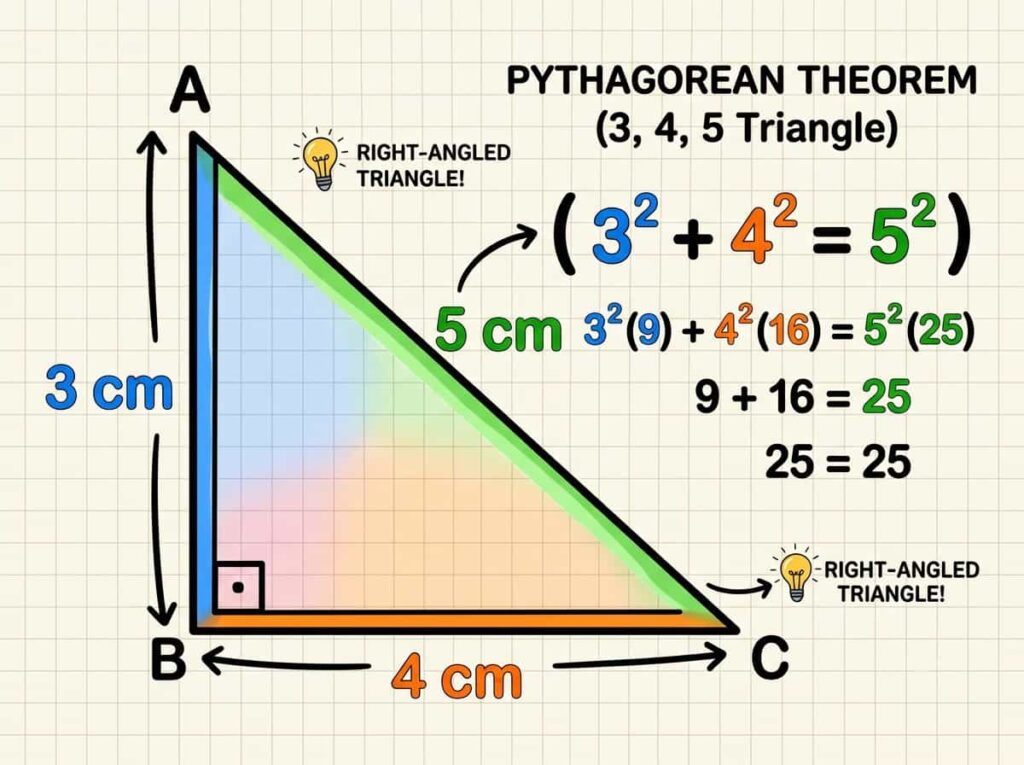
Let’s start with the most famous example of all – the 3-4-5 triangle.
Problem: A right-angled triangle has shorter sides of length 3 cm and 4 cm. What is the length of the hypotenuse?
Solution:
- Label the sides: $a = 3$, $b = 4$, $c = ?$
- Use the formula: $a^2 + b^2 = c^2$
- Substitute the values: $3^2 + 4^2 = c^2$
- Calculate the squares: $9 + 16 = c^2$
- Add: $25 = c^2$
- Square root both sides: $c = \sqrt{25} = 5$
Answer: The hypotenuse is 5 cm
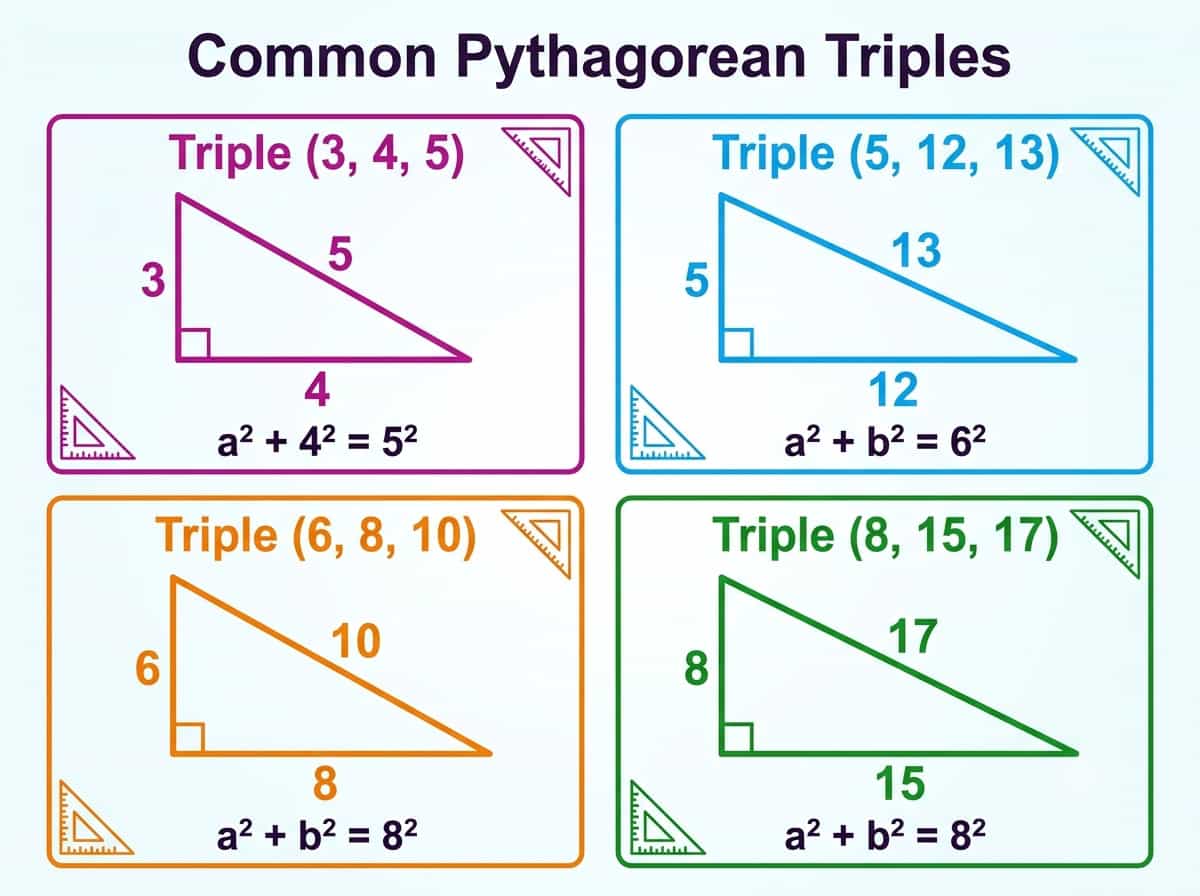
Why this is special: 3, 4, and 5 are called a Pythagorean triple – three whole numbers that fit the theorem perfectly. Other examples include 5-12-13 and 8-15-17.
Example 2: Finding a Shorter Side
Problem: A right-angled triangle has a hypotenuse of 13 cm and one shorter side of 5 cm. What is the length of the other shorter side?
Solution:
- Label the sides: $a = 5$, $c = 13$, $b = ?$
- Use the formula: $a^2 + b^2 = c^2$
- Substitute the values: $5^2 + b^2 = 13^2$
- Calculate the squares: $25 + b^2 = 169$
- Subtract 25 from both sides: $b^2 = 169 – 25 = 144$
- Square root both sides: $b = \sqrt{144} = 12$
Answer: The other shorter side is 12 cm
Example 3: A Real-Life Problem – The Ladder
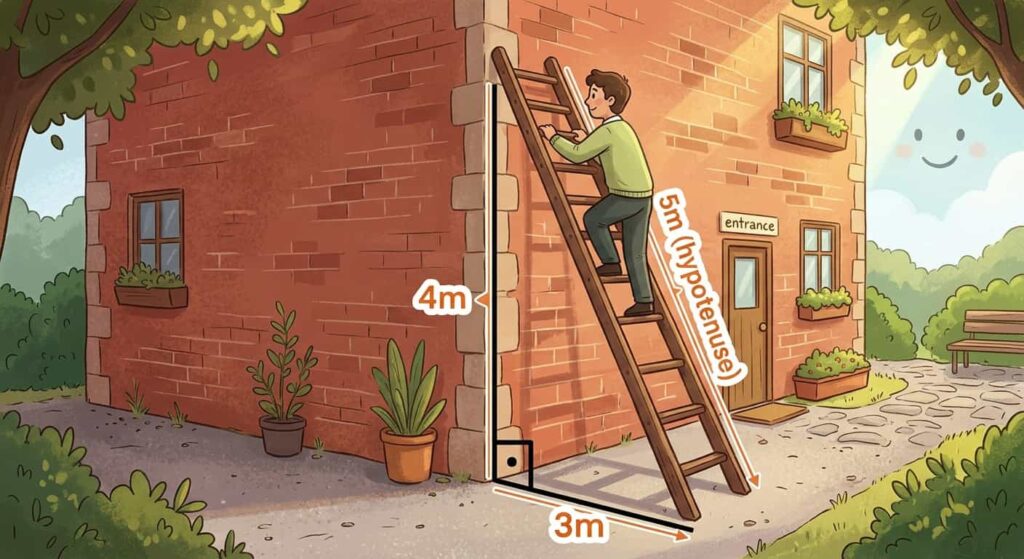
Problem: You have a ladder that is 5 metres long. You want to lean it against a wall so that the bottom of the ladder is 3 metres away from the wall. How high up the wall will the ladder reach?
Solution:
This forms a right-angled triangle where:
* The ladder is the hypotenuse: $c = 5\text{ m}$
* The distance from the wall is one shorter side: $a = 3\text{ m}$
* The height up the wall is the other shorter side: $b = ?$
- Use the formula: $a^2 + b^2 = c^2$
- Substitute: $3^2 + b^2 = 5^2$
- Calculate: $9 + b^2 = 25$
- Subtract: $b^2 = 25 – 9 = 16$
- Square root: $b = \sqrt{16} = 4$
Answer: The ladder will reach 4 metres up the wall.
Why Is Pythagoras’ Theorem So Useful?
Pythagoras’ Theorem isn’t just something you learn for an exam – it has real-world applications everywhere!
In Construction and Building
Builders use the 3-4-5 rule to make sure walls and corners are perfectly square (at right angles). If a triangle has sides 3, 4, and 5, the angle between the 3 and 4 sides MUST be 90 degrees!
In Navigation and Mapping
When you look at a map and want to find the shortest distance between two points, you’re using Pythagoras’ Theorem – especially if the points aren’t directly north-south or east-west of each other.
In Technology
TECH APPLICATIONS
- Computer graphics use Pythagoras’ Theorem to calculate distances between points on a screen
- GPS systems use it to work out your location
- Engineers use it when designing everything from bridges to roller coasters
In Everyday Life
DAILY USES
- ✓ Finding the shortest path across a park
- ✓ Working out if your TV will fit in a certain space
- ✓ Calculating the length of a diagonal across a rectangle or square
How to Check if a Triangle is Right-Angled
Here’s a clever trick: If you know all three sides of a triangle, you can check if it has a right angle by using Pythagoras’ Theorem backwards.
The rule: If $a^2 + b^2 = c^2$ (where c is the longest side), then the triangle is right-angled.
Example: Does a triangle with sides 8, 15, and 16 have a right angle?
* Check: $8^2 + 15^2 = 64 + 225 = 289$
* $16^2 = 256$
* Since $289 \neq 256$, then NO, it’s not right-angled
Example: Does a triangle with sides 6, 8, and 10 have a right angle?
* Check: $6^2 + 8^2 = 36 + 64 = 100$
* $10^2 = 100$
* Since $100 = 100$, then YES, it is right-angled!
Quick Summary
| What | The Rule |
|---|---|
| Pythagoras’ Theorem | In a right-angled triangle, $a^2 + b^2 = c^2$ |
| Hypotenuse | The longest side, opposite the right angle |
| Finding the hypotenuse | $c = \sqrt{a^2 + b^2}$ |
| Finding a shorter side | $a = \sqrt{c^2 – b^2}$ |
| Who discovered it? | Named after Pythagoras (570-495 BC), but known to earlier civilisations |
| Pythagorean triple | Three whole numbers that fit the theorem (e.g., 3, 4, 5) |
KEY TAKEAWAYS FOR REVISION
- ✓ Pythagoras’ Theorem ONLY works for right-angled triangles
- ✓ The hypotenuse is always the longest side and is always opposite the right angle
- ✓ The theorem is about areas as well as side lengths – the square on the hypotenuse equals the sum of the squares on the other two sides
- ✓ You can use the theorem to find any missing side of a right-angled triangle if you know the other two
- ✓ You can also use it backwards to check if a triangle is right-angled
Summary
Pythagoras’ Theorem is over 2000 years old, but it’s still one of the most used mathematical rules in the world today. Every time you see a right angle, whether it’s in a building, a video game, or a map, there’s a good chance Pythagoras’ Theorem is working behind the scenes!
So the next time someone asks you what the most famous maths rule is, you can confidently say: “$a^2 + b^2 = c^2$ – and I know exactly what it means!”
Frequently Asked Questions: Pythagoras' Theorem Mastery
Q1: How to prove Pythagoras' Theorem?
One of the easiest ways to prove the theorem is by using the Area of Rearrangement method. Imagine a large square with side length (a + b) that contains four identical right-angled triangles with sides a, b, and c arranged around an inner tilted square of side c. The total area of the large square is (a + b)² = a² + 2ab + b². Alternatively, the total area can be calculated by adding the areas of the four triangles and the inner square: 4 × (½ab) + c² = 2ab + c². Setting the two area equations equal to each other gives a² + 2ab + b² = 2ab + c². Subtracting 2ab from both sides proves the theorem: a² + b² = c².
Q2: Does Pythagoras' Theorem work on all types of triangles?
No. Pythagoras’ Theorem strictly works ONLY for right-angled triangles (triangles containing one 90-degree angle). It cannot be used directly on acute or obtuse triangles. For non-right triangles, mathematicians must use more advanced trigonometric rules like the Law of Cosines.
Q3: What is a Pythagorean Triple?
A Pythagorean Triple is a set of three positive integers (a, b, c) that perfectly satisfy the formula a² + b² = c². The most common whole-number examples encountered by students in school exams are (3, 4, 5), (5, 12, 13), (6, 8, 10), and (8, 15, 17).
Q4: What is the Converse of Pythagoras' Theorem?
The converse states that if the square of the longest side of a triangle is exactly equal to the sum of the squares of the other two shorter sides (a² + b² = c²), then the triangle is guaranteed to be a right-angled triangle. This is the exact method used by engineers to check if a constructed corner is perfectly square.
Q5: How do you identify the hypotenuse if a triangle is rotated or turned upside down?
The position of the hypotenuse never changes based on rotation; it is always the side located directly opposite (across from) the 90-degree right angle indicator square. It is also physically always the longest individual side length in the triangle.
Q6: Can the side lengths of a right-angled triangle be decimals or fractions?
Yes, the side lengths can be any positive real numbers, including fractions, decimals, or square roots (e.g., a triangle with sides 1.5 cm, 2 cm, and a hypotenuse of 2.5 cm is a valid right triangle). Only when all three sides are whole numbers is the set called a Pythagorean Triple.
Q7: What happens to the formula if you need to find one of the shorter sides instead of the hypotenuse?
If you already know the hypotenuse (c) and want to find a shorter side (a or b), you must rearrange the equation using subtraction instead of addition. The modified side calculation formulas are written as a = √(c² – b²) or b = √(c² – a²).
Q8: Why did ancient civilizations like the Egyptians use 3-4-5 rope loops?
Ancient Egyptian builders used a rope tied with 12 equally spaced knots to form a triangle with side ratios of 3:4:5. Because these numbers satisfy Pythagoras’ Theorem, stretching the rope tight automatically created a perfect 90-degree right angle, which was essential for laying the foundational stone corners of the pyramids safely.
Q9: How is Pythagoras' Theorem used to find the distance between points on a coordinate graph?
On a standard Cartesian grid, you can find the distance between any two points (x₁, y₁) and (x₂, y₂) by drawing imaginary vertical and horizontal lines to form a right triangle. The horizontal distance is Δx = (x₂ – x₁) and the vertical distance is Δy = (y₂ – y₁). The direct distance between the points is the hypotenuse, calculated as: Distance = √((x₂ – x₁)² + (y₂ – y₁)²).
Q10: Is it possible for a right-angled triangle to have two hypotenuses?
No. A triangle only has three sides total, and because a triangle can never contain more than one 90-degree internal angle, there can only ever be one side that lies opposite the right angle. Therefore, every right-angled triangle possesses exactly one unique hypotenuse.