
Welcome to the Army Public School Babina digital learning portal. These specialized chapter notes are curated specifically to help our students master core Physics concepts and prepare efficiently for upcoming school and board examinations.
Two Ways to Measure Movement
Have you ever walked to school and wondered exactly how far you’ve travelled? Or perhaps you’ve watched a football player sprint up and down the pitch and thought about the ground they’ve covered?
In physics, we have two different ways to measure how far something has moved. These are called distance and displacement. While they might sound similar, they are actually quite different, and understanding this difference is crucial for anyone studying physics.
APS BABINA STUDY TIP
- Don’t worry if this sounds confusing right now — by the end of this article, you’ll be able to confidently explain the mechanical differences between these two values to your classmates!
What is Distance?
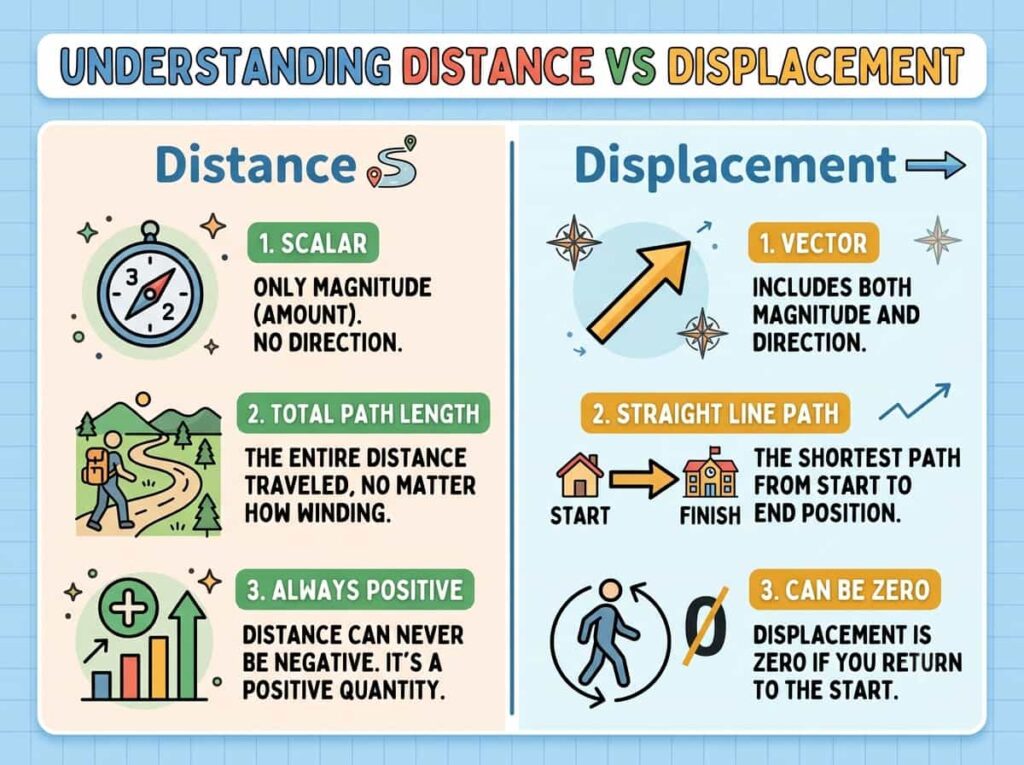
Distance is a scalar quantity. But what does that mean? Simply put, a scalar quantity only has magnitude (size or amount) — it doesn’t care about direction.
Distance is the total length of the path travelled by an object, regardless of which way it went.
Think of it like this: If you walk from your house to the shops, then to the park, and finally back home, the distance you’ve travelled is the total number of steps you’ve taken along the entire route.
KEY FEATURES OF DISTANCE
- ✓ It is always positive (you can’t have a negative distance length).
- ✓ It depends entirely on the specific path taken.
- ✓ It can never decrease as you keep moving (it only adds up).
- ✓ It is measured using SI base units of metres (m), or secondary units like kilometres (km).
What is Displacement?
Displacement is a vector quantity. This means it has both magnitude (size) and direction.
Displacement is the straight-line distance from the starting point to the ending point, along with the direction of that line.
Imagine you’re playing a game of “find the treasure” on a grid. If you start at point A and end at point B, displacement is simply the straight line between these two points, regardless of how many twists and turns you took to get there.
KEY FEATURES OF DISPLACEMENT
- ✓ It can be positive, negative, or exactly zero.
- ✓ It only depends on the initial starting and final ending points, completely ignoring the path taken.
- ✓ It must state a coordinate direction (e.g., North, South, East, West, Left, Right).
- ✓ It is measured in metres (m) accompanied by a mandatory directional label.
The Main Difference: It’s All About Direction!
The most important difference between distance and displacement is that distance ignores direction, while displacement includes it.
| Distance | Displacement |
|---|---|
| Scalar quantity (just a magnitude number) | Vector quantity (numerical magnitude + direction) |
| Total integrated path length | Straight-line vector change in spatial position |
| Always a positive scale value | Can be positive, negative, or completely zero |
| Directly altered by the route taken | Independent of route; relies only on start/end positions |
| Tells you “how much total ground was covered” | Tells you “how far out of place the object is overall” |
Core Concepts Infographic
Example 1: Walking a Winding Path and Back Home
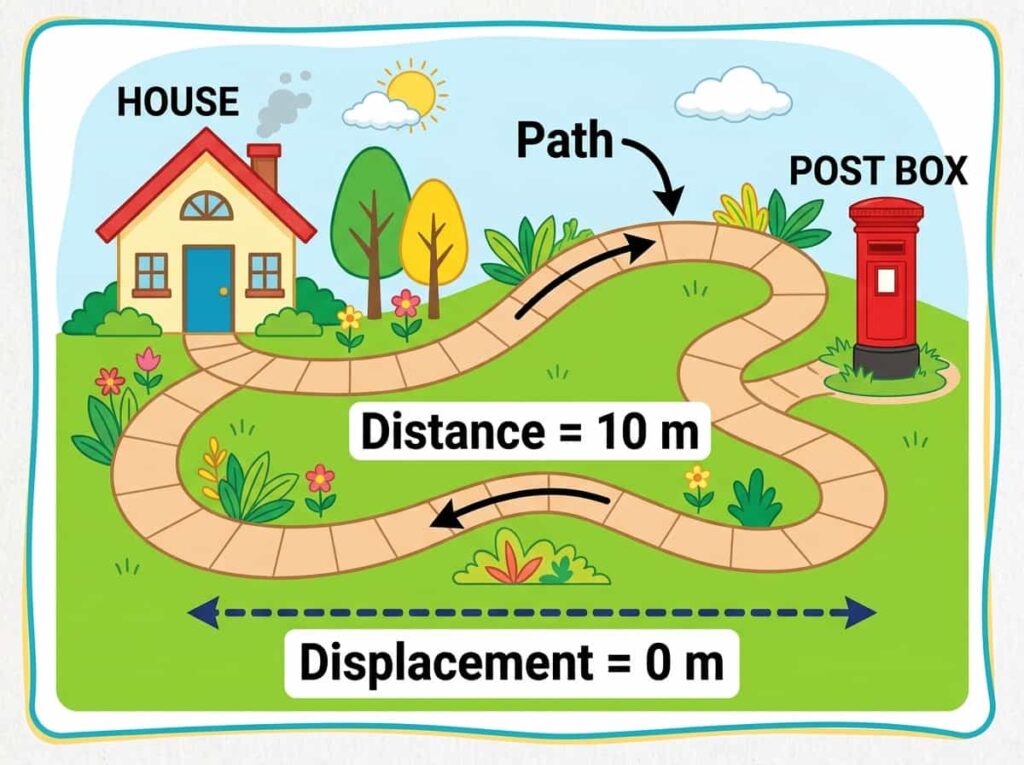
Let’s look at this everyday scenario. Imagine you step out of your house, follow a winding sidewalk to a local post box, and walk straight back through your door.
SCENARIO METRICS
- Total Path Distance Travelled: 10 metres
- Final Vector Displacement: 0 metres (You returned precisely to your origin point!)
This is a brilliant example of why distance and displacement are different. You’ve physically moved your body a total of 10 metres (distance), but your overall spatial change in position is zero (displacement) because you are standing right back at the starting point.
Example 2: Taking the Scenic Route
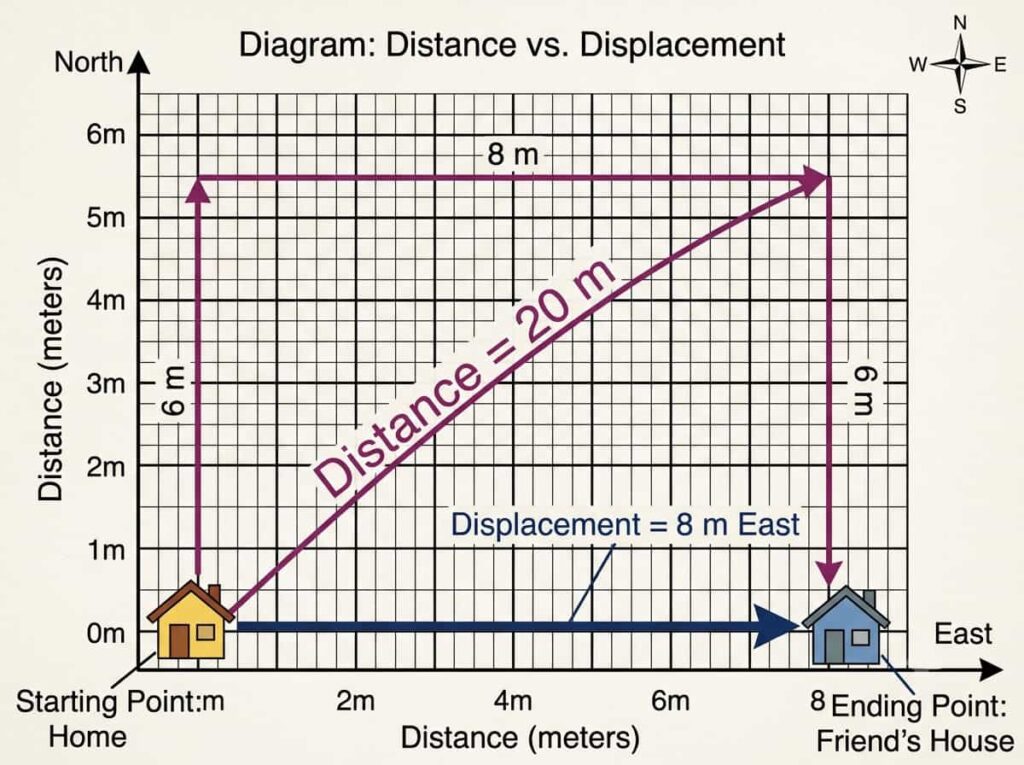
Let’s look at a more complex dimensional path plotted on a coordinate grid.
Your friend lives directly 8 metres East of your house. Instead of walking straight down the street, you decide to take a scenic route around the block: you walk 6 metres North, turn and walk 8 metres East, and finally turn and walk 6 metres South to arrive at your friend’s house.
SCENARIO CALCULATIONS
- Distance Travelled Calculation: 6m + 8m + 6m = 20 metres total path length covered.
- Displacement Calculation: Shortest straight line from start to finish is exactly 8 metres pointing directly East.
Even though your fitness tracker reports you walked 20 metres, your physics displacement vector is strictly 8 metres East because that value defines how far away from your starting landmark you finished.
Why Does This Matter?
Understanding the operational difference between distance and displacement is fundamental in physics because:
- It directly affects motion equations: When calculating scalar speed, we divide distance by time. When calculating vector velocity, we divide displacement by time.
- It forms navigating logic: Understanding displacement helps computational programs calculate optimal straight-line paths between distinct targets.
- It acts as a foundation for advanced mechanics: Complex kinematic fields like acceleration vectors, momentum, and balanced force fields require a perfect command of initial vector displacement.
Frequently Asked Questions: Distance vs Displacement
Q1: What is the difference between distance and displacement?
Distance is a scalar quantity that measures the total length of the actual path travelled by a moving object, regardless of direction. Displacement is a vector quantity that measures the shortest straight-line path from the object’s initial starting point to its final ending point, accompanied by a specific direction.
Q2: Can the magnitude of displacement ever be greater than the distance travelled by an object?
No. The magnitude of displacement can never be greater than the distance. Displacement represents the shortest possible straight line between two points. Therefore, the magnitude of displacement is either equal to the distance (when moving in a straight path without changing direction) or less than the distance (when moving along a curved or multi-directional path).
Q3: An athlete completes one full lap around a circular track of radius R. What is their total distance and net displacement?
When the athlete completes one full round and returns to the exact starting line, the total distance travelled is equal to the circumference of the track, which is given by the formula 2πR. However, because their initial position and final position are identical, their net displacement is exactly zero.
Q4: An object moves 3 metres East and then turns right to move 4 metres South. What are the distance and displacement?
The total distance travelled is simply the sum of both path lengths: 3m + 4m = 7 metres. To find the displacement, we apply the Pythagorean theorem to calculate the straight-line hypotenuse from start to finish: √(3² + 4²) = √(9 + 16) = √25 = 5 metres. The final displacement is written as 5 metres Southeast.
Q5: Under what specific condition will the distance travelled by an object equal the magnitude of its displacement?
Distance and the magnitude of displacement are strictly equal only when an object travels along a perfectly straight line and continues moving in a single, unchanging direction. If the object turns, curves, or reverses direction at any point, the distance will immediately become greater than the displacement.
Q6: Can an object have a negative displacement? Can it have a negative distance?
Yes, an object can have a negative displacement because it is a vector quantity; a negative sign simply indicates that the object has moved in the opposite direction of the chosen positive reference coordinate axis. Conversely, distance can never be negative because it is a scalar value that strictly accumulates path length as long as motion occurs.
Q7: A student walks half a round clockwise along a circular track of radius R. Calculate the distance and displacement magnitude.
For a half-circle journey, the distance travelled is half of the track’s circumference, which equals πR. The displacement is the straight line connecting the starting point to the opposite side of the circle, which is exactly equal to the diameter of the track, or 2R.
Q8: If the displacement of a moving body is zero, does it mean that the distance covered by the object is also zero?
Not necessarily. A zero displacement simply means the object ended its journey at its original starting location. While the distance is zero if the object never moved at all, the distance can be highly positive if the object travelled along a round-trip route, a winding path, or a closed loop and then returned home.
Q9: How do distance and displacement affect the calculation of Speed versus Velocity?
Distance is a scalar property used to calculate average speed (Total Distance / Total Time). Because speed depends on distance, it has no direction. Displacement is a vector property used to calculate average velocity (Net Displacement / Total Time). Therefore, velocity always possesses both a numerical value and a structural direction matching the displacement vector.
Q10: A car travels 100 km North, turns around, and drives 120 km South along the exact same highway. What is its final position status?
The total distance accumulated by the odometer is 100 km + 120 km = 220 kilometres. Taking North as the positive direction (+100 km) and South as the negative direction (-120 km), the net displacement calculation is (+100 km) + (-120 km) = -20 km. This means the car’s final displacement is exactly 20 kilometres South of its original starting line.